

Providing compliant fire separation between household units remains a critical requirement in residential construction, particularly in terraced housing and multi-unit developments.
Under Acceptable Solution C/AS1 4.1.1, each household unit must be fire separated from adjacent units. While the clause does not specifically mention roof eaves, in practice the vertical fire separation often needs to continue through the eaves space and terminate at the fascia to maintain the required fire resistance.
GIB® Intertenancy Barrier Systems are designed to help resolve this detail. By extending GIB Barrierline® into the eave, builders and designers can maintain the required separation while accommodating common roof configurations. The system is suitable for eaves up to and including 1200mm wide and includes guidance on forming cantilevered arrangements where required.
The approach provides a practical way to address one of the more complex junctions in intertenancy construction, while remaining aligned with the requirements of C/AS1.
Where additional roof eaves protection may be required for adjacent units, GIB® also advises designers to refer to GIB Weatherline® fire-rated soffit solutions.
As medium-density housing continues to expand across New Zealand, compliant and clearly detailed intertenancy systems are becoming increasingly important for designers, builders and consent authorities alike.
Fire separations within eaves
In accordance with Acceptable Solution C/AS1 4.1.1 each household unit shall be fire separated from other household units. Although this does not specifically mention eaves, it typically requires the vertical fire separation to be extended out into the eaves, terminating at the fascia.
With GIB® Intertenancy Barrier Systems eaves fire separation can be resolved by extending the GIB Barrierline® into the eave as shown in Figure 1. This is suitable for eaves up to and including 1200mm wide. The GIB® Intertenancy Barrier Systems literature shows how a cantilever can be formed.
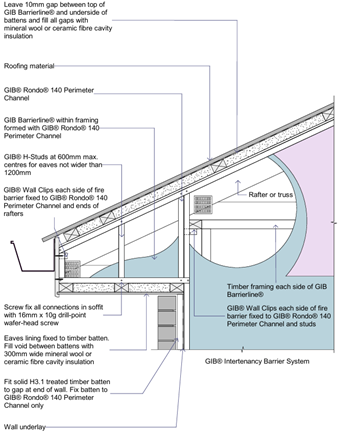
Figure 1 – GIB Barrierline® cantilever providing eaves separation
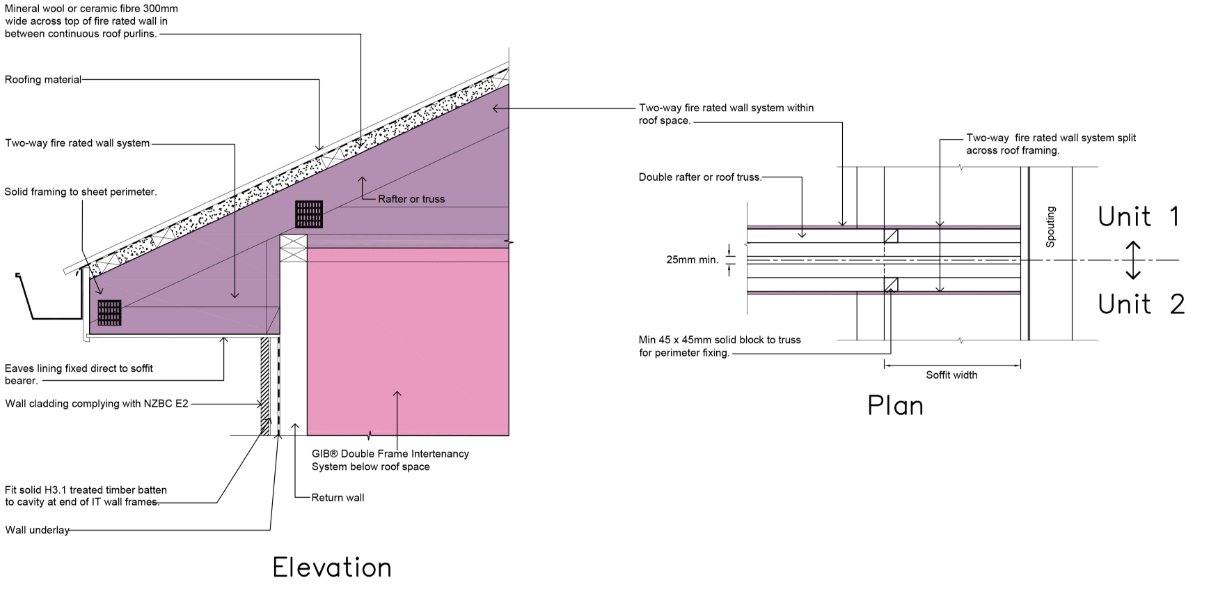
For a double frame IT wall system eaves separation may be resolved by applying a suitable two–way FRR wall system within the eave space as shown in Figure 2.
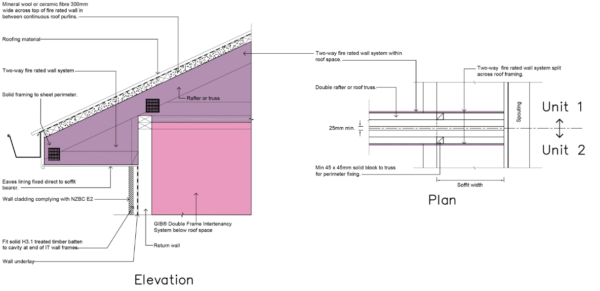
Figure 2 – Double Frame IT Wall System eave separation
If similar two-way fire protection was to be applied to a GIB® Intertenancy Barrierline® system, then mineral wool or equivalent would be needed to pack the gap at system transition. See Figure 3.
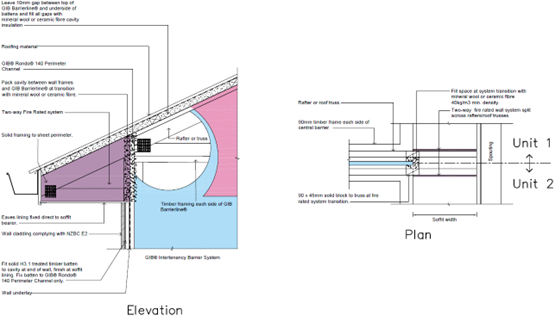
Figure 3 – GIB Intertenancy Barrierline® System with eaves separation
For smaller spaces blocked with a minimum 90mm solid timber (or 45mm rafters each side), no plasterboard lining would be required to maintain a 30-minute fire separation. This is shown in Figure 4.
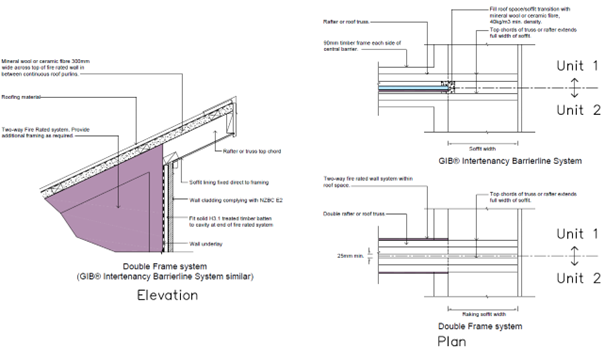
Figure 4 – Solid timber providing eaves separation
Acceptable Solutions C/AS1 and C/AS2 do not specifically address roof eaves protection for adjacent units. Should this be required, refer to GIB Weatherline® fire rated soffit solutions.
For any questions please call the GIB® Helpline 0800 100 442.