

National and Labour are both promising fiscal responsibility, leaving buyers, developers and banks to drive the next construction recovery. But with ACT and the Greens pulling from either flank, what the sector ultimately gets will again depend on coalition arithmetic.
New Zealand’s construction industry is entering the election campaign with forward indicators improving, but little evidence yet of a recovery on site.
The country consented 40,581 new homes in the year to June, up 19% on the previous year. Yet the value of building work completed in the March quarter was $7.2 billion, down 5.9% from a year earlier. In seasonally adjusted volume terms, total activity fell 3.5% during the quarter, with residential work down 2.2% and non-residential construction down 4%.
That supports the headline that residential construction is beginning to recover, but not yet in company order books.
Westpac expects homebuilding to lift later this year, but questions whether the momentum will last into 2027 as interest rates and construction costs rise and house prices remain soft. The Reserve Bank is similarly cautious. Its May Monetary Policy Statement forecasts an increase in residential investment during 2026, but a slower one than previously expected as higher diesel and materials costs and rising mortgage rates weigh on projects.
The next government may therefore inherit a recovery, but it cannot rely on one. Nor is either major party promising to manufacture a building boom through a large new programme of Crown expenditure.
National is offering regulatory reform and tighter spending. Labour is allowing itself somewhat more fiscal room, but its announced construction policies remain targeted. The sharper alternatives sit outside the two major parties: ACT wants government to retreat further, while the Greens want it to build at scale.
National bets on reform
National’s construction proposition is a wager that private investment will respond if planning delays, consenting costs, product restrictions and liability risks are reduced.
Its most consequential policy is the replacement of the Resource Management Act with a Planning Act and a Natural Environment Act. The Government estimates the new system could eliminate between 15,000 and 22,000 consent and permit applications each year, consolidate more than 100 plans into 17 regional plans and produce $13.3 billion in administrative and compliance savings over 30 years.
Those are government estimates and will depend heavily on implementation. The direction, however, is clear: National wants more projects to become viable because they are faster and cheaper to approve, not because the Crown is paying for them.
The Building Amendment Bill follows the same supply-side logic. Now before a select committee, it would introduce proportionate liability for defective building work, professional indemnity insurance requirements for design professionals, mandatory warranties for new homes and major renovations valued at $100,000 or more, and greater collaboration or consolidation among building consent authorities. It would also create a faster consent pathway for qualifying sustainable and solar-equipped homes.
The opportunity is lower cost and greater certainty once the new systems are established. The risk is another transition during which councils, insurers, designers, builders and developers must interpret new rules. Deregulation can reduce the cost of a project, but it cannot make an unprofitable development bankable if buyers or lenders are absent.
National’s record on housing density also complicates its promise of certainty.
The party first supported Labour’s bipartisan Medium Density Residential Standards, then withdrew that support and campaigned on allowing councils to opt out. The Coalition subsequently enabled Auckland Council to withdraw the plan change implementing those rules and required its replacement to provide capacity for just over two million homes. In February, after more than 10,000 submissions and strong opposition to the proposed intensification, Housing Minister Chris Bishop reduced the minimum to 1.6 million.
The Government argues this will focus growth around the city centre, rapid transit and town centres while giving Auckland more control elsewhere. Even so, the sequence shows how quickly housing policy can change under political and coalition pressure.
National has retained targeted public investment. Budget 2026 included a $400 million Incentives for Growth Fund for councils and additional support for between 1,800 and 2,250 social homes over three years from 2028/29. But those commitments do not amount to a materially larger spending tap.

ACT pushes the wager further
ACT would reinforce National’s reform programme while pressing harder for lower spending across government.
Its housing and infrastructure policy begins from a strong property-rights position: people should generally be free to build unless they cause material harm to others or the environment. It supports infrastructure funding mechanisms intended to make growth pay for growth and proposes “innovation trials” that would allow selected regulations to be suspended temporarily so new construction technologies or methods could be tested under defined safety conditions.
An ACT-influenced government would therefore be likely to accelerate National’s deregulation while resisting a broad increase in public housing or construction spending. For the sector, that could mean a more permissive operating environment, but little direct help with weak near-term demand.
Labour finds more room, but not much more building
Labour’s fiscal strategy permits a somewhat larger role for government, although considerably less than its critics on the right suggest or the Greens would prefer.
The party is targeting a surplus in 2029/30, net debt of 20% of GDP “over time”, and core Crown spending and revenue of about 33% of GDP once its capital gains tax is fully implemented. National wants spending reduced towards 30% of GDP and net core Crown debt brought below 40% over time.
Those settings are not identical, but both parties are presenting themselves as fiscally restrained. Labour has not yet published a capital allowance or a complete timetable for its debt target, and its proposed 28% capital gains tax is earmarked for healthcare rather than housing or infrastructure.
Its confirmed construction policies are selective. A $950 million Crown guarantee for Community Housing Funding Agency borrowing is intended to reduce financing costs for community housing providers. It is not $950 million of immediate spending. Labour would also extend Apprenticeship Boost payments to two years, widen the eligible trades, provide $1,000 grants for tools and fund additional mentoring.
Both measures could help. The guarantee may allow existing providers to deliver more homes from the same investment, while training support could prevent another loss of apprentices during the downturn. Neither, by itself, creates a large new pipeline.
Labour has supported the Building Amendment Bill at first reading, including its move towards proportionate liability, while reserving the right to test the detail at select committee. That makes a wholesale reversal of those reforms less likely. Its position on the RMA replacement is less defined. Labour has said it will not tear down everything the Government has done simply for political reasons, but has yet to specify which parts of the new planning system it would retain or amend.
On the policies announced so far, Labour’s approach remains “steady as she goes”: wider fiscal parameters, a new property tax and targeted interventions in community housing and training, but no return to a large state-led residential building programme.
The Greens pull Labour towards building
The Greens provide the clearest pressure for a Labour-led government to spend more directly on construction.
Their housing policy promises “tens of thousands” of public homes and finance for councils and community housing organisations. Their energy programme includes $200 million for community energy, solar installations on more than half of public homes within four years and $80 million for renewable energy in Māori housing.
For a sector with spare capacity, that is the most direct demand stimulus offered by a parliamentary party. But a future government would not inherit a dormant Kāinga Ora pipeline that could simply be switched back on.
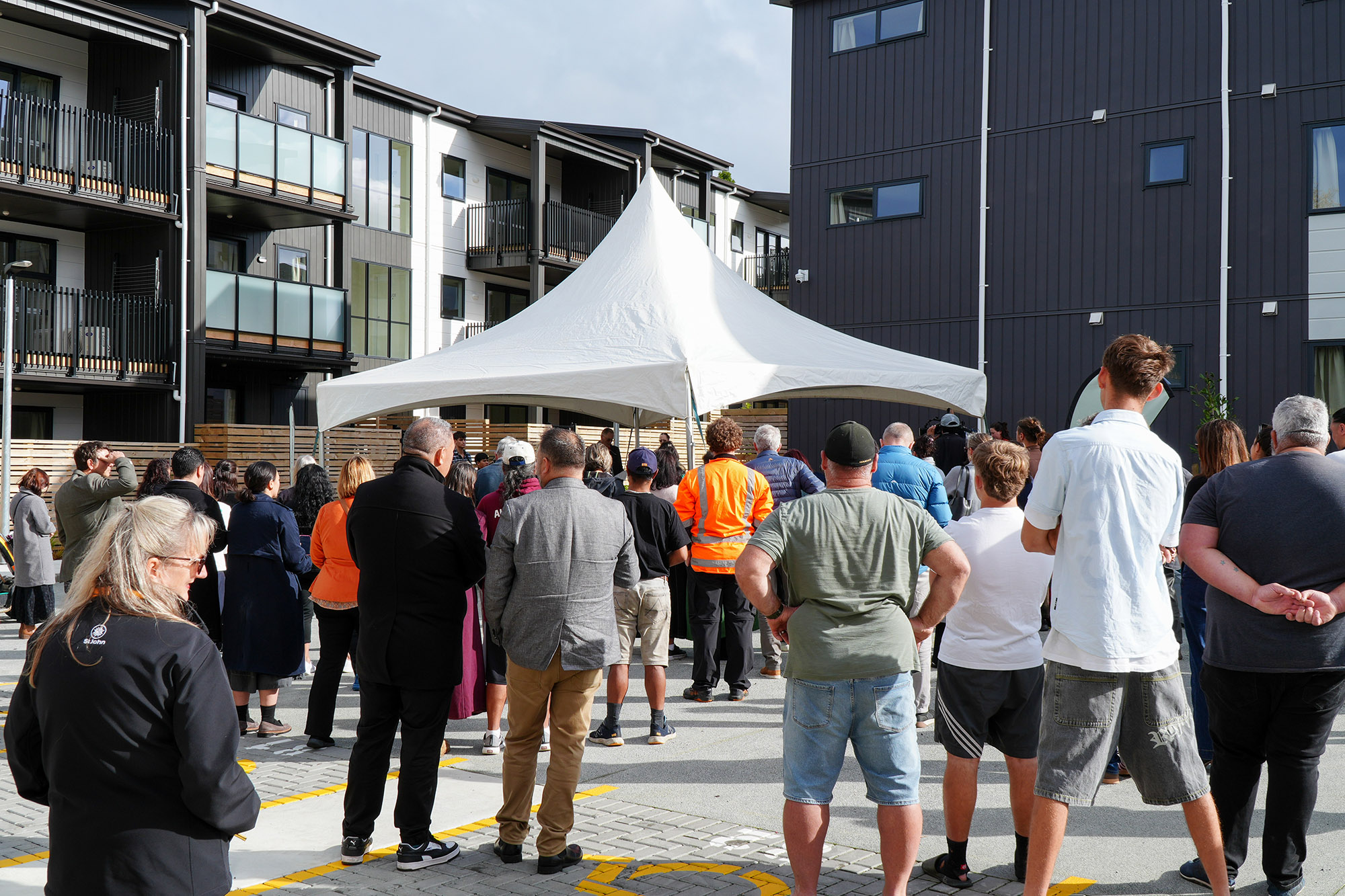
As part of its financial reset, Kāinga Ora reviewed more than 460 proposed social-housing projects. It decided 212 would not proceed at that stage because they no longer stacked up financially or were not in the locations where housing was required. Between $150 million and $180 million had already been spent on projects that would not proceed as originally planned, while land intended for sale required an estimated $40 million writedown.
A Labour-Green government could rebuild that pipeline, but it would need to reassemble sites, designs, consents, procurement relationships and delivery capacity before additional funding became work on site. Poorly sequenced, a rapid programme could lift land, wage and material costs rather than completed-home numbers. Properly staged through a soft market, it could preserve capacity that might otherwise be lost.
The economists warn against easy answers
The economic argument is not simply more spending versus less.
Bernard Hickey has described Labour’s fiscal strategy as a “low-target” version of the bipartisan status quo, only slightly looser than National’s. His argument is that both parties have constrained the Crown balance sheet while expecting indebted households, developers and financially stretched councils to fund the infrastructure needed for growth.
On that reading, neither major party is offering enough to address the backlog in housing, water, transport, climate adaptation and public assets, let alone drive construction into a strong growth cycle.
Cameron Bagrie provides the warning from the other direction. He observed earlier this year that housing had “failed to fire” despite the wider economy beginning to turn. He has also emphasised the need for political stability and a credible infrastructure pipeline, warning against projects being cancelled and reinstated whenever governments change.
Both arguments can be true. More money without sound project selection, procurement and sequencing will not necessarily produce more infrastructure. But efficiency reform cannot substitute indefinitely for investment. A perfectly prioritised project that remains unfunded still creates no work, no asset and no productivity gain.
Buyers, banks and coalition arithmetic
As with the last election, two forces may matter more to construction than the major parties’ headline promises.
The first is the market. National and Labour are both promising fiscal responsibility rather than a Crown-funded boom. That leaves home buyers’ confidence, developers’ ability to make projects stack up and banks’ willingness to lend as the most important drivers of construction demand next year. Consent growth will matter only if finance is available and customers are prepared to sign contracts.
The second is coalition politics. National’s platform would be pulled towards a smaller state and faster deregulation by ACT. Labour’s would be pulled towards substantially more public housing and energy investment by the Greens. Housing density has already shown that even policies presented as settled can be rewritten by electoral pressure, partner demands and local opposition.
The election therefore offers the construction sector different regulatory settings, targeted assistance and competing theories of how growth begins. It does not offer a guaranteed pipeline.
The practical outcome will be decided twice: first in the credit committees of the banks and the decisions of buyers, then around the coalition table after election night.
The views expressed in this article are the author’s own and do not necessarily reflect those of CMS.